


+8615061447755


A crawler PV pile driver runs on rubber tracks and a wheeled PV pile driver runs on tires — and that single chassis difference decides which machine can work your site, how fast it moves between posts, and what it costs to run. Choose a tracked chassis when the terrain is soft, ungraded, or sloped; choose a tire-based unit when the parcel is graded, firm, and large enough that fast road transfer between sections pays off. The rule of thumb procurement teams use: ground condition first, post volume second, transport distance third. This guide compares the two chassis types on ground pressure, mobility, productivity, cost, and transport, with the typical specification numbers that actually drive the decision. For contractors qualifying a PV foundation piling machine from a solar piling equipment manufacturer or OEM factory, the chassis choice is the first spec to lock down — it constrains everything else.
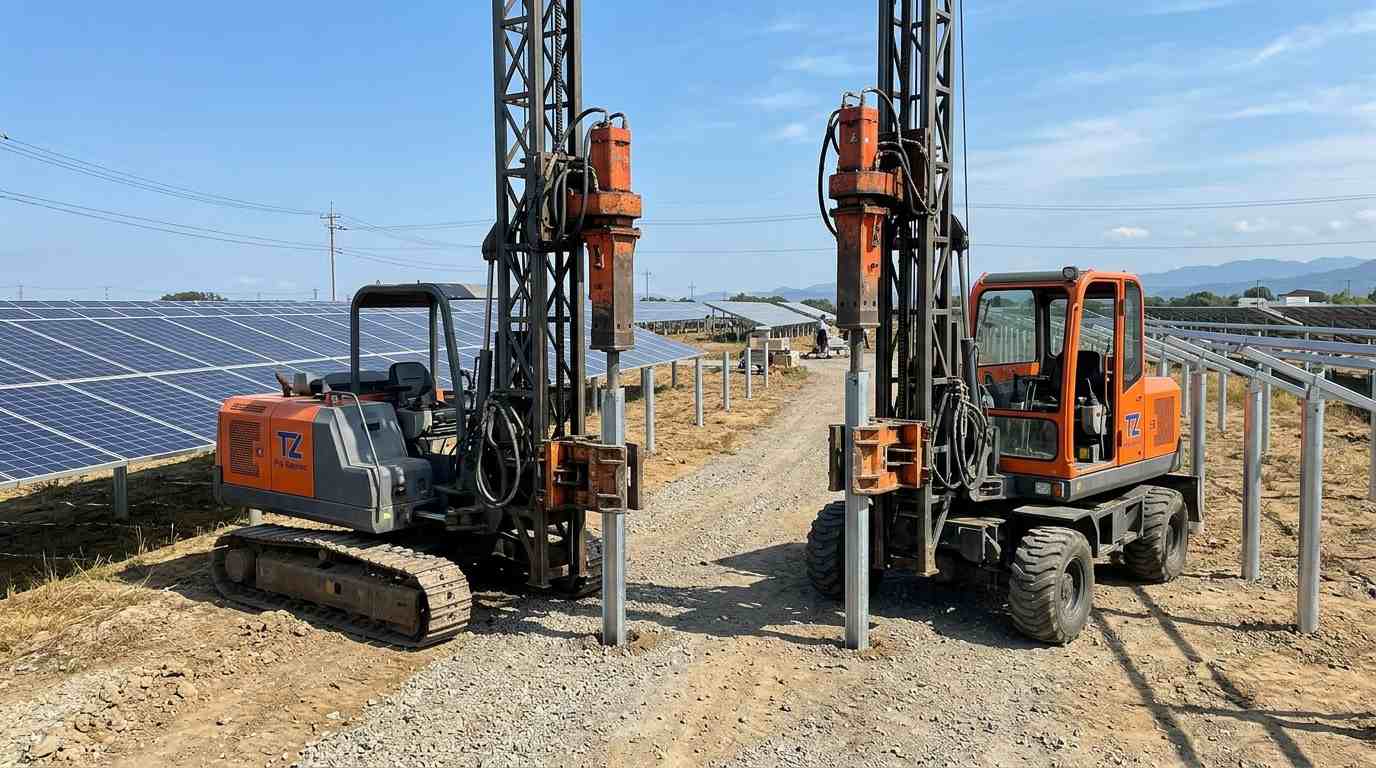
A crawler PV pile driver (tracked chassis) is the default for soft, ungraded, or sloped solar fields: its tracks spread weight over a large contact area, giving typical ground pressures of 35–55 kPa, so it keeps working where tire-based units bog down. A wheeled PV pile driver (tire chassis) is the better choice on firm, graded parcels: it transfers between sections at 20–30 km/h versus roughly 1–5 km/h for a crawler, cutting reposition time on large uniform sites.
Rule of thumb: crawler for terrain, wheeled for speed. When in doubt on a large mixed site, the crawler's uptime usually outweighs the wheeled unit's transfer advantage.
| 35–55 kPa Typical crawler ground pressure |
20–30 km/h Wheeled road-transfer speed |
~30° Crawler slope capability |
300–400 mm Crawler ground clearance |
A crawler PV pile driver is a PV foundation piling machine mounted on a tracked (crawler) undercarriage. The tracks distribute machine weight across a large contact patch, producing typical ground pressures of 35–55 kPa — low enough to cross soft, ungraded, or recently graded soil without rutting. Key characteristics:
The crawler's advantage is not speed — it is the ability to keep working on terrain where a tire-based machine would stall. On a multi-hundred-megawatt parcel with soft spots, that uptime difference usually outweighs slower transfer times.
A wheeled PV pile driver mounts the same piling hardware — mast, hydraulic impact unit, feed system — on a tire chassis, often derived from rough-terrain or truck-style carriers. Its defining trait is speed on firm ground:
The wheeled configuration is essentially a productivity play: on a large, uniform, firm site, the time saved in transfer and setup across thousands of posts is substantial. The trade-off is that one wet week can idle the machine entirely — which is why the terrain assessment matters more than the sticker price.
| Specification | Crawler (tracked) | Wheeled (tire) |
|---|---|---|
| Ground pressure | 35–55 kPa (typical) | High; concentrated on 4 tires |
| Travel speed | 1–5 km/h | 20–30 km/h |
| Slope capability | Up to ~30° | ~15–20°, firm surfaces only |
| Ground clearance | 300–400 mm | 350–500 mm (carrier-dependent) |
| Turning | Zero-radius counter-rotation | 6–9 m radius |
| Soft / wet terrain | Works; tracks self-clean and grip | Bogs down; high rut risk |
| Transport between sites | Lowbed trailer required; tracks assembled on arrival | Drives itself on graded routes |
| Maintenance focus | Track tension, undercarriage wear | Tires, steering, suspension |
Ground pressure — measured in kilopascals (kPa) — is the single specification that separates the two chassis types. It determines whether the machine can cross your soil without leaving ruts that later complicate grading, cable-trench work, and array alignment.
This is why experienced procurement teams treat the geotech and site-drainage survey as part of the machine spec, not an afterthought. The survey tells you which chassis class the site can actually carry.
Driving speed at the post is similar between chassis types — the impact unit and mast do the work. The productivity difference comes from what happens between posts:
Industry field experience indicates that dedicated foundation equipment can complete professional foundation work up to roughly 60% faster than improvised carrier-mounted setups — the chassis choice then determines how much of that advantage survives your specific site conditions.
| Logistics factor | Crawler | Wheeled |
|---|---|---|
| Moving between sites | Lowbed trailer + track assembly/disassembly | Self-driven on firm routes |
| Mobilization time | Longer; track setup on arrival | Shorter; arrives ready |
| Remote site access | Trailer must reach the site; tracks cross rough final approaches | Needs graded access for the last leg |
| Container shipping (export) | Flat-rack or breakbulk typical | Often fits open-top or flat-rack |
For remote solar builds in the Middle East, Africa, or Southeast Asia — where access roads are often still under construction — the crawler's ability to cross rough final approaches frequently decides the logistics plan. For builds near established haul networks, the wheeled unit's self-mobility simplifies daily moves.
Purchase prices for the two configurations sit in comparable bands for similar piling capacity, so the decision usually comes down to operating economics:
| Your site condition | Recommended chassis |
|---|---|
| Soft, wet, or ungraded soil | Crawler — low ground pressure is mandatory. |
| Sloped or benched terrain over 15° | Crawler — tracks hold grade a tire cannot. |
| Large, firm, graded parcel | Wheeled — transfer speed compounds at scale. |
| Established haul roads on site | Wheeled — self-mobility cuts trailer cycles. |
| Mixed terrain with rock outcrops | Crawler 3-in-1 platform (ram + down-the-hole + auger) handles soil and rock on one chassis. |
| Both solar and road-safety contracts | A highway guardrail post driver covers roadside posts; pair it with the PV unit by chassis class. |
TeZhong Machinery is a China-based PV foundation piling equipment manufacturer and supplier (CE & ISO9001 certified, 15+ years, OEM-capable) building crawler and wheeled solar farm piling platforms plus ram/DTH/auger 3-in-1 machines, with 24/7 technical support. As a direct factory we configure the chassis class, mast, and hammer to your terrain survey and project scale — share your site details for a recommendation.


+8615061447755
 Rede IPv6 suportada
Our hours
Quer seja feriado ou festival, teremos alguém para o receber 24 horas por dia e responder-lhe no menor tempo possível.
Hi! Click one of our members below to chat on
