


+8615061447755


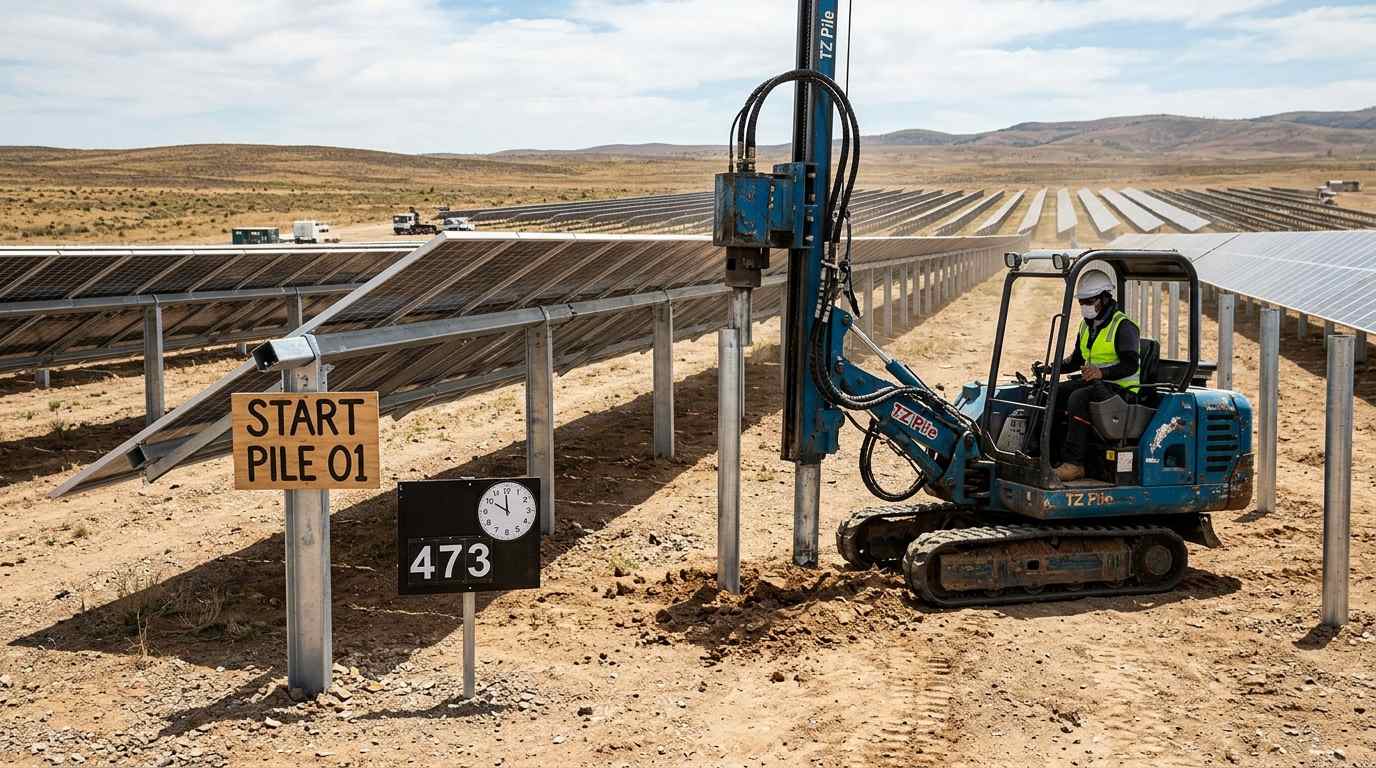
One machine drives about 50 piles in one hour, and about 400 piles in a normal 8-hour working day. That is the baseline Anhui TeZhong Machinery Technology Co., Ltd. uses when a contractor asks how many PV foundations a single rig can cover, and it is a factory figure rather than a site measurement: no soil type, pile length, pile diameter, operator skill or shift boundary is attached to it, and no measured output has been recorded for a named project. This article sets out what the 400 actually means, which machine specifications move it, and which numbers we would not put into a programme. If you are sizing a fleet, our solar piling rig for utility-scale sites range is where that baseline is usually quoted; our roadside post driving equipment units start from the same figure, though a highway job has a different cycle. Figures current as of 16 November 2026.
Anhui TeZhong Machinery Technology Co., Ltd. quotes about 50 piles per hour and about 400 piles per 8-hour working day for one machine. That baseline does not state soil type, pile length, pile diameter, operator skill, or whether the count includes moving between rows. No third-party test report backs it, and no measured output has been recorded for a named project. Use 400 as a starting point only, and run a trial pile on your own ground before the number goes into a schedule.
As of 16 November 2026, 50 × 8 = 400. The hourly and daily figures are one baseline, not two independent measurements.
|
50 piles / hour
Hourly baseline
|
400 piles / 8 h
8 × 50, not a site measurement
|
1,260–1,460 J
Impact energy options, TZ536 / TZ8000
|
105–120 L
Diesel tank capacity, not consumption
|
About 50. In a normal 8-hour working day, about 400. Two numbers, one sentence pair that has been in circulation for years, with no conditions attached — and that absence of conditions is the part that matters. We have kept the figures as they stand rather than rounding them into a cleaner claim.
| Question | Figure | Boundary you need to know |
|---|---|---|
| Piles per hour | About 50 | No soil type, pile length or pile diameter stated |
| Piles per 8-hour day | About 400 | The same answer, multiplied by eight |
| Diesel per 8-hour day | About 200 L | An 8-hour burn rate, not a tank size |
| Efficiency versus other suppliers | A 20% advantage is claimed for the parts we use | Our own statement, with no third-party test report behind it |
| Capacity and certification | 500 units per month; CE and ISO9001 | Factory capacity, not a site output rate |
That is the whole numerical basis for a daily output figure. Specifications describe a machine; they do not describe your ground. If a supplier quotes you a guaranteed daily count, ask which ground it was measured on and who signed the record. We would rather say plainly that we do not have that document.
The daily figure is the hourly figure multiplied by eight. That is worth spelling out, because buyers sometimes treat 50 and 400 as two separate performance claims. They are one claim. The table below does nothing except divide and multiply the baseline — every line is labelled so nobody mistakes arithmetic for a site forecast.
| Line | Calculation | What this line actually is |
|---|---|---|
| One hour | 50 piles | The hourly baseline |
| One 8-hour shift | 8 × 50 = 400 piles | The daily baseline |
| A 4,000-pile site | 4,000 ÷ 400 = 10 shifts | Arithmetic on the baseline, not a measured project rate |
| A 40,000-pile site | 40,000 ÷ 400 = 100 shifts | Same arithmetic; ignores weather, ground and downtime |
| Two machines | No multiplier exists | There is no measured fleet output figure |
Notice the last line. We ship 10-unit orders and 5-unit orders, but no measured output figure exists for a fleet, and we are not going to invent one here. Dividing a pile count by 400 gives you a number of shifts on paper. It does not give you a programme.
The machine sets the ceiling before the ground does. A 4.0 m mast and an 8.0 m mast are not doing the same job, and a 52 kW unit is not a 91 kW unit. The values below are current as of 16 November 2026; a blank means no figure is available, not that the dimension is zero.
| Model | Pile driving height | Drilling depth | Drilling diameter | Rated power |
|---|---|---|---|---|
| TZ536 crawler | 5.5 m | 5.0 m | 50–400 mm | 75/91 kW |
| TZ680 wheeled | 5.5 m | 5.0 m | 50–400 mm | 91 kW |
| TZ8000 | 8.0 m | 7.5 m | 50–400 mm | 91 kW |
| TZ670 crawler | 6.0 m | — | 50–400 mm | 91 kW |
| TZ630 | 4.5 m | — | 50–300 mm | 75 kW |
| TZ585 mini | 4.0 m | — | 50–300 mm | 52 kW |
The TZ536 and TZ8000 both offer two hydraulic hammer options: 1,260 J at 450–900 bpm (295 kg hammer, 440 kg working weight) and 1,460 J at 450–700 bpm (500 kg hammer, 650 kg working weight). Both carry a 105 L fuel tank; the TZ680 carries a 120 L explosion-proof resin tank. Tank capacity is not fuel consumption — roughly 200 L over an 8-hour shift is a separate number, and no per-model consumption table exists.
Hammer heads can be made for H-shaped, C-shaped, square and round piles. Changing the pile changes the tooling, and driving steel piles directly into hard rock can make piles refuse to penetrate, drop construction efficiency and damage the equipment. The method used there is impact plus rotation with a down-the-hole rock drilling unit and drill rods. That is a different operation from ramming, so the 50-per-hour figure should not be carried across to it.
In soft soil, drilling efficiency can vary by nearly double even between adjacent areas with almost identical ground conditions. The gap comes from downforce control, hydraulic responsiveness and the ability to keep working continuously — not from engine power. Chasing drilling speed too hard causes collapsing hole walls, accumulated drill debris and misaligned holes, which cost more time than they save. There is no correction factor that turns the 400 baseline into a site-specific number.
Movement between piles is the other part. Remote control works at about 100 m and the machines move efficiently between piles and between rows; one person can complete all piling tasks on the TZ650; the wheeled TZ680 can cut site-to-site transfer time by up to 40%. None of those savings converts into piles per hour. A 40% shorter transfer says nothing about how long each pile takes.
Then there is the pile itself. A 5.5 m machine handles piles under 5.5 m and any pipe type as long as the dimensions are supplied; an 8.0 m machine handles piles under 8 m. Longer posts, deeper holes and hard layers each add operations to a single pile, and the baseline does not say which of those it counted.
The question worth asking of any piling rig is whether it can hold stable operation after 6–8 hours of continuous work. That window is where a machine either holds its pace or starts losing it, and the answer has to do with stable downforce, hydraulic response and consistent operation, not a bigger engine.
Long shifts also change what the hardware has to survive. Continuous vibration and impact load hydraulic connections, travel components and structural joints. On the TZ536 the hose-to-travel-motor bracket was reinforced, steel plate thickness increased, and connecting bolts upgraded from M10 to M12. A larger discharge opening clears drilling debris from the working area, and the control system is protected against dust. Wear and maintenance are a design issue on sites running long hours. A reliable machine is one that keeps working when conditions get demanding.
No hour-by-hour decay curve exists, so 400 over eight hours should not be read as eight identical 50-pile hours. What we can offer is a test run including piling operations, shown by online video or witnessed at the factory, and video outgoing-inspection before shipment. Ask to see the machine doing your pile, not a catalog number.
Six things need fixing before a daily number means anything. This is the list our engineers work through on a configuration enquiry — not a formula, because no formula exists.
| Fix this first | Why it changes the count |
|---|---|
| Pile drawing and longest post | 5.5 m, 6.0 m and 8.0 m machines are different builds; H / C / square / round heads are made to drawing |
| Geotechnical layers | Soft soil can vary by nearly double; rock needs impact drilling instead of direct driving |
| Shift length and climate | The baseline assumes a normal 8-hour day; long hours bring wear, dust and heat into the calculation |
| Repositioning method | Remote control at about 100 m and wheeled transfer on the TZ536 / TZ539 / TZ680 affect time between rows |
| Crew and operator | One-person operation is possible on the TZ650; the baseline says nothing about crew size |
| Verification before the programme | A test run with piling operations and video outgoing-inspection are the checks available before shipment |
Send those six items. As the factory and OEM supplier, we will come back with a model, its specifications and a written configuration sheet. We will not send a guaranteed piles-per-day number for ground we have not seen. A daily figure belongs in a contract only after a trial pile on the site — for complex projects our engineers will visit the site before the recommendation is made.
We would rather point at these than have you find them during a claim. First, mast travel. One specification gives the TZ536 4.5 m of effective travel with 1.0 m of compensation height, drilling 5.0 m holes and driving 5.5 m piles. Another description of the same machine gives 5 m of travel plus 1 m of compensation, handling piling work below 6 m and drilling below 5.5 m. The TZ680 has the same split: 4.5 m + 1.0 m and 5.5 m piles in one place, 5.0 m + 1.0 m and 6.0 m piles in another. Ask for the value on the signed configuration sheet.
Second, efficiency. A 20% advantage over other suppliers is claimed for the parts we use, with no third-party test report behind it; we would not use it to knock 20% off a construction programme. Third, fuel. Roughly 200 L over an 8-hour shift is a burn rate; 105 L and 120 L are tank sizes on two different machines. A tank size is not a shift's consumption, and the two should not be reconciled by assumption.
Fourth, the 15 years of manufacturing experience and the 2010 founding date in the Su-Xu High-tech Economic Development Zone in Suzhou, Anhui are both company statements. CE and ISO9001 certificates, the signed configuration sheet and a trial-pile record are what we ask buyers to check before a number becomes contractual.
It does not tell you the soil, the pile length, the pile diameter, the embedment depth or the pile shape. The baseline names none of them.
It does not tell you whether setting out, moving between rows, changing drill rods, refuelling or clearing spoil were included in the eight hours. The boundary of the count is not defined.
It does not tell you the operator's experience, the number of machines on site, or what happens in hour seven. The 6–8 hour question has been raised, but no decay curve exists.
It is not a third-party measurement, not a warranty term and not a contractual output guarantee. The warranty covers the machine, not a daily production rate.
What it is: a factory baseline, useful as a starting point and nothing more. If a number has to survive a client's scrutiny, get it from a trial pile on that client's ground.
How many piles can a PV piling rig drive in one hour?
About 50, with about 400 in a normal 8-hour working day. No soil type, pile length, pile diameter or operator skill is attached to those figures, and no third-party test report backs them. Treat 50 per hour as a manufacturer's baseline, current as of 16 November 2026.
Is 400 piles per 8-hour shift a guaranteed output?
No. In soft soil, efficiency can vary by nearly double even between adjacent areas with almost identical ground, and rock needs a different method entirely. The 400 figure is arithmetic on the 50-per-hour baseline, not a site measurement. A binding daily rate should come from a trial pile on your ground and a signed record.
Does the 20% higher efficiency claim have a test report?
No. That line is a statement about the parts we use, not a measured comparison, and we would not use it to shorten a programme. What we can show you are the CE and ISO9001 certificates, the machine specifications, and a test run including piling operations on the unit you are buying.


+8615061447755
 Rede IPv6 suportada
Our hours
Quer seja feriado ou festival, teremos alguém para o receber 24 horas por dia e responder-lhe no menor tempo possível.
Hi! Click one of our members below to chat on
